Updated 12 August 2013, minor addition & correction.
15 November, 2010
13 Dec 2010, video link re 3AR/3LO added
March 2012, 3WV antenna updates and video link re 3WV.
18 December 2014 minor additions
13 March 2021 Special Update including more detail on 2CO Aerial for Al in Oz.
10 April 2021 minor change.

Other Broadcast Equipment

Antennas

Melbourne engineering firm Johns & Waygood under contract to STC
built the masts of this design for 2CO Corowa, 5CK Crystal Brook and 6WF Hamersley in Perth.

Within about four years, the technology of MF antennas (and associated earthing)
being constructed by the same company had revolutionised.   see below

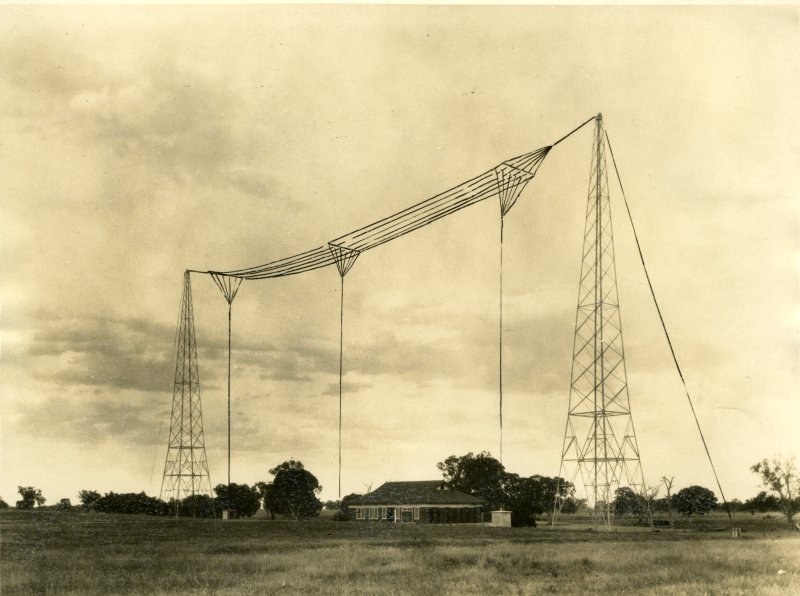
This antenna is one of 3 built.
The others are at Crystal Brook, S.A. and Hamersley in Perth, W.A.

The antenna is an example of the historic Multiple Tuned Downlead type.
This antenna predates the vertical mast and radial earth systems
developed later in the 1930s.

When 2CO started, it used 560 kHz, then the lowest broadcast frequency
station in Australia.

The original power was 7,500 Watts.(DC anode input)
Motor generator equipment was used to generate
the DC voltages for the original equipment.

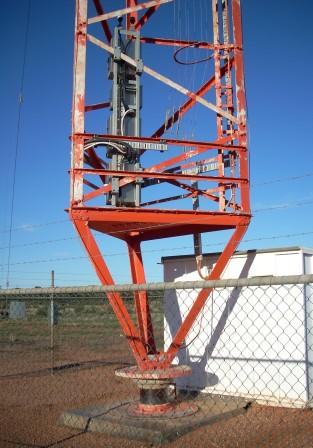
The antenna has a sign on it;
"Manufactured for Standard Telephones and Cables A/Asia Ltd
Johns and Waygood Ltd Engineers South Melbourne"

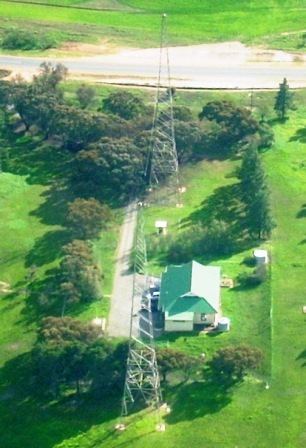
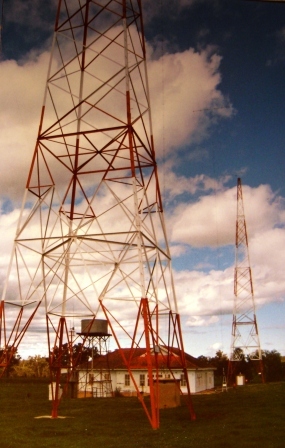
The white building is the original 1931 transmitter building.
It has since been demolished and replaced by a small transportable hut with "Ifco"or similar on it.

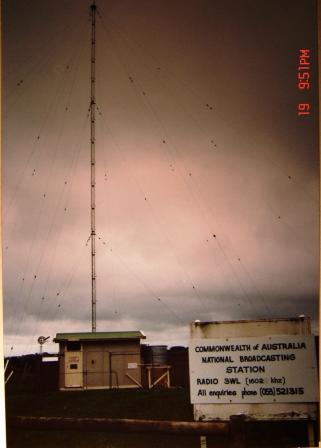
2coant

1931 building and antenna; 1987 photo.

2COabcfoto

ABC Photo of 2CO Corowa in 1931

2CO down lead tuning equipment, housed in a brick hut.

The antenna current is about 11 Amps in each down lead.
The total vertical current over the 3 leads is thus around 33 Amps.

The multiple tuned down lead was developed in the early years of
Wireless to improve the effiency of long wave antennas.

The breakthrough was to use multiple (3)separate earths
each with its own vertical down lead and tuning coil.

The current is divided between 3 coils and earths thus
cutting by 3 the total "current squared" energy losses.

topwires

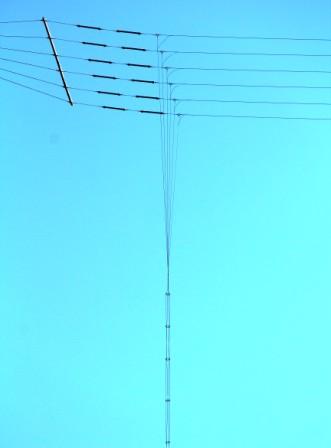
There are 6 parallel flat top wires strung between the 180 foot high masts.
The spacing between each adjacent flat top wire is 4 feet(1.22 m).
The wires are 230 feet long.
The 3 down leads are each made of 4 wires on a 4 inch circle.

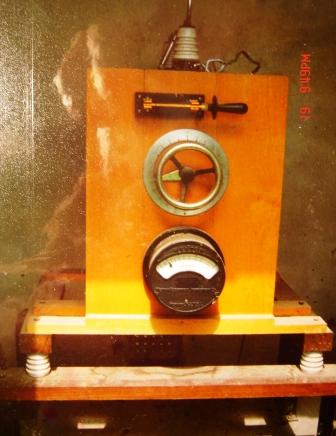
2CO Antenna tuning box

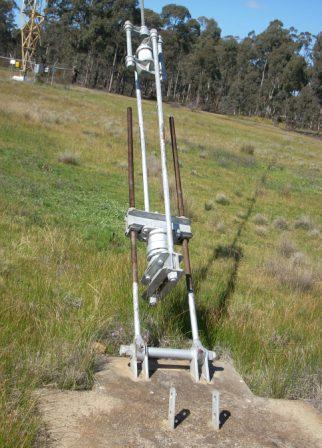
Inside Down lead Tuning Box. This is one of three; one for each down lead.
The function of the tuning inductor is also to
divide the antenna/earth current equally between three earths.

5CK antenna
5CK Crystal Brook original antenna and building in August 2009.

This antenna was already in use when the ABC commenced. A small antenna tuning hut can be seen. This aerial now stands-by for a 180 metre mast in the next paddock. It is now a T antenna rather than multiple downlead.

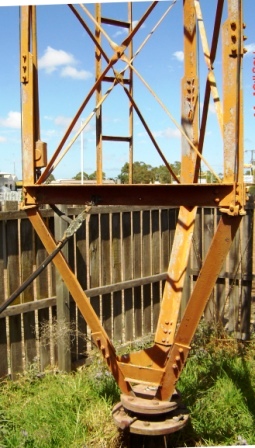
Johns and Waygood Masts - Anti-Fading Radiator

In 1938, just a few years after the 2CO antenna was erected,
the new Australian Broadcasting Commission had modern stations erected
in the capital cities and some regional areas.

The new transmitting stations replaced the original privately built stations.
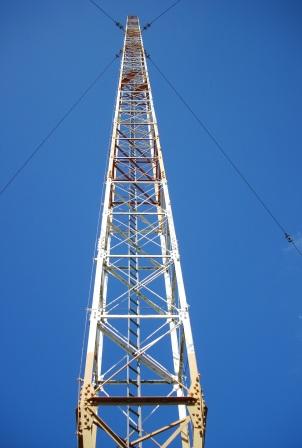
The new stations had 580 to 740 feet tall anti-fading masts; approximately 200 metres height.
Some had their height electrically increased by a top capacitive armature and
an inductor in a tuning hut at the top.

The inductor is made of hollow copper tube, with power wires for a mast top light. The inductor is about 400 mm dia. and about 600 mm tall, I am told.

The tall masts increase the range of the signal during the day but more importantly; increase fade free range at night from about 55 km to 150 km.

Johns and Waygood ceased mast manufacture in about 1965.
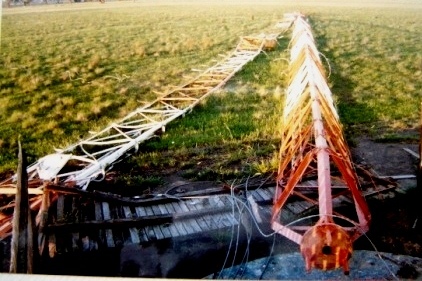
Their last mast was at Mt Burr, S.A.
It collapsed (and was rebuilt) during guy tensioning when the guy anchor block broke.

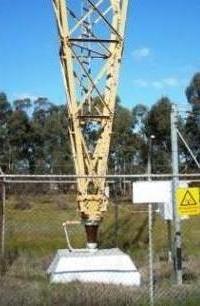
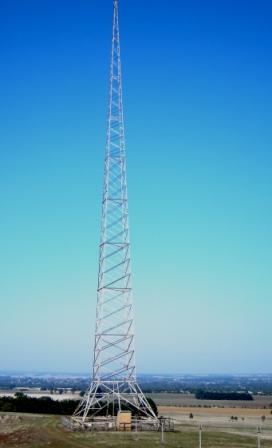
6GF bottom

This particular mast is only 123 metres tall.
It appears to be a shorter and less heavily constructed
Johns & Waygood version of its capital city brothers.

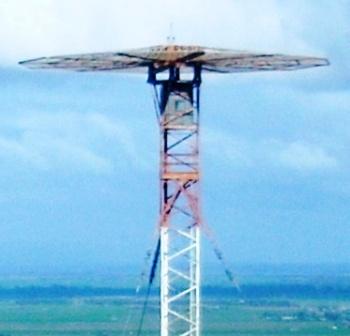
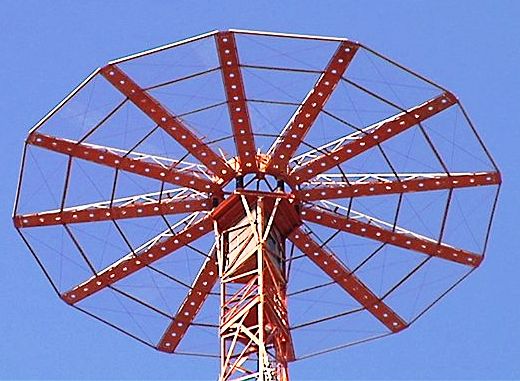
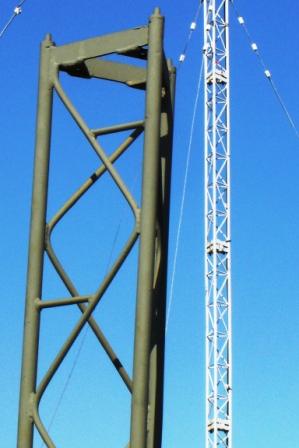
3wv top showing tuning hut and insulators

3WV Top Hat; 2012 photo taken by Corey Hague of ABC Radio used with his kind permission.

Shortened Antifading Radiator

An anti-fading radiator for the low frequency end of the MF broadcast band would be very tall.   An economical solution is to use a shorter mast with top loading, thereby saving around 50 metres height and a small fortune.

The mast shown is 660' ie 201 metres tall with an 18 metre diameter 4.2 ton capacitor structure on the top.  It is connected to the mast physically by long insulators and electrically by a tuning coil inside the hut just below.

The tuning hut, made of thick copper or brass, is entered via a trap door in the floor.
Inside the hut is the tuning inductor that is about 600 mm diameter and 600 mm long.
there is enough space to get past the coil to the trap door in the roof to go up to the top hat.

The 3 legs are made of 6" by 6" by ¾" steel.
Weight of structure and guys: 58 tons.

3WV commenced transmission on 25 February 1937.
3WV antenna was the first of its type in Australia.
The first transmitter was a 10 kW STC with a black front panel.  
Same transmitter type was also used at 6WA and 2CR.
3WV also used the first solid state 50 kW transmitter MF transmitter in Australia from the early 1990s.

Similar antennas are at 6WN/6WF Perth, 6WA Wagin, 2CR Cumnock, 2GL Glen Innes.

In recent decades a similar result has been achieved using an
insulated gap in the mast with a tuning coil across the gap.

Link to ABC Video of 3 minutes re 75 years of 3WV

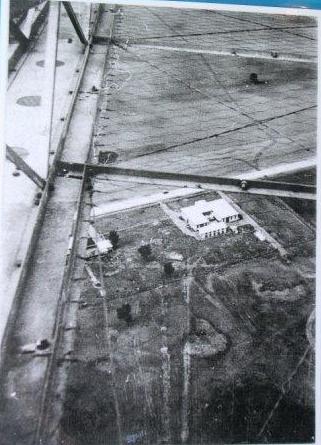
3WV wire mesh
View of 3WV from the top loading capacitor in about the 1940s.
The building was made of triple brick wallls.
Photos kindly supplied by Mr Ray Leerson.

Ray's shoes


View from just below the tuning hut in 1971.

The building structure cracked up due to soil movement and was demolished when the STC transmitters were replaced by physically smaller Nautel units in 1990's.
The signal has been heard in Japan, South Africa and Canada.

Metter's Masts


Typical of many of the same type erected in 1950's.

This mast shown was standing 277 feet tall in April 2007.

Travellers on the Hume Highway can see a 312 foot example
of 3NE next to the Highway at Wangaratta.

The three pictures below are all of the same mast in Cavan Rd, Dry Creek.
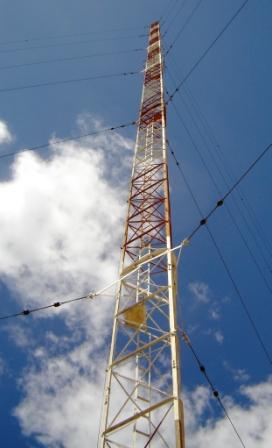
It was jointly used by 5AD & 5KA and later by 5RPH.

Former 5KA 5AD, Cavan Rd Mast, Adelaide, 11 Jan 2007
Cavan Rd Mast Base

Cavan Rd Mast now scrap metal in early December 2007

The mast was not standing in December 2007 when the site was revisited.

Meet Mr Mast Master; courtesy Herald Sun 2 June 1992
(the file may take a little time to load)

3SR Mast

3SR Shepparton

Total length of the antenna was 425 feet.

3SR Shepparton; Metters Mast

This antenna appears to be from the same factory as the
5AD/5KA antenna in the photos above above.

I visited this station in summer 1968/9 with 3SR technician, Mr Smith, he told me it was a Metters Mast but I forgot until reminded in 2008, then I had a flash back to 40 years earlier.   Interesting how the brain works.

This antenna was erected in about 1956 and dissused about 1987.
The lease on the site ran out; the elderly site owner refused to renew the lease.
Contracts were let for the construction of a new facility on the opposite side of Dookie Rd.
The site owner died; the new site owner/s were happy for the mast to remain, but it was too late to cancel the new contract.

Interesting mast 3HA on Mount Bainbridge

Built in 1941 this mast's height is 247', 75 metres.
Interestingly it is on top of a volcanic hill;
not considered ideal for MF but
half a centuary later for good real estate for FM transmission.
The FM signal has been heard in the Antarctic.

Tapered masts are not normally considered ideal for MF
due to the vertial profile of the current distribution along the length being less than ideal.
(The current drops off lower down than on a uniform cross section mast)
The mast is insulated from earth and has an insulated mounting for anti-twisting.

3hamastweb

The original 1941 transmitter antenna power was 750 Watts, 10.6 amps.
The transmitter was powered by a small fuel oil generator.

antitwistweb

Mast erected for AWA

The mast and guy below were erected for
an AWA station in about 1956 in rural Victoria.
The mast is about 257 ft (78 m) tall.

The mast has 4 sides, most only have 3 sides.
Four sided masts were commonly erected for AWA in the 1950s.
Other examples are at Collie in Western Australia and "Super" 3UZ.

Mast at AWA built station Bendigo
bobotweb
2 Kangaroo hopped past 20 metres from me just as I put the camera away
The guy insulation and tensioning system
seems elaborate and expensive by modern standards.
It looks original.

The station, built to last in a red brick building,
originally had AWA 1 kW transmitters
very similar to the unit shown covered in sparrow droppings.
See AWA Transmitters page.

This antenna's 200 Ohm transmission line is described below.

Youtube video of 450 ft 4 sided mast also built about 1956

AWA 200 Ohm Transmission line

AWA built many AM broadcast transmitter stations using
6 wire 200 Ohms transmission line.

The inner two wires are the active, the 4 outer wires are the earthed screen.

200lineweb
AWA 200 Ohm Transmission line at Wagga Wagga

AWA built many AM broadcast transmitter stations using
6 wire 200 Ohms transmission line.

The inner two wires are the active, the 4 outer wires are the earthed screen.

Deeko Mast sections<br>3WL Warrnambool in 1992
Deeco Mast sections
at
3WL Warrnambool in 1992

6GF stand-by
& others

The mast height in the photo is 102 feet.

The building and antenna in this photo were replaced a year or two after this.
The wind mill in the background is now gone;
replaced by houses to the horizon as Warrnambool expands.

The transmitter was a 250 Watt solid state made by STC.
The site is still almost the same but different building, mast, and sign.
The water tank may still be the same.

The antenna was built of "Deeko" 6 foot (1.8 m) mast sections
that were for built several decades after WW2 in Sydney.
They were also used at Emu S.A. to support long haul shortwave communications for the Totem atomic tests.

The a.m. broadcast station mast at Alice Springs uses another sort of Deeko mast.

No doubt many thousands of these 6 foot sections were built.
After late 1960s the sections were made in 2 metre sections. The vertical tubes are centred on a inch triangle.
The weight varied between models up to 20 kg.
They are easily transported by utility or aircraft.

They can also be seen supporting radio and TV antennas and supporting hay shed roofs etc.

Deeko mast sections were used for many military installaions.
The large majority were used for H.F. (short-wave).
No doubt used for many smaller government broadcast towers and Non-Directional Beacons (NDB) for aircraft guidance.
ABC MF stand-by aerial at Kalgoorie is 108 feet of 6 foot sections.
2GB Sydney stand-by mast uses 84 feet high with 8 umberella top load wires sloping down.

After government disposal, they are in use at low budget radio stations, as well as TV reception,
amateur radio stations and supporting hay shed roofs.

A retired radio engineer told me that when he started work in the early 1950s many Deeco masts could be seen along the road from Darwin to Adelaide.

Deeko also went on to manufacture a stronger 2.0 metre long section. A problem with some sections was that the lengths of all 3 sides were not exact.
Tall masts could be curved like a banana unless packing shims were insteted.

Thanks to Andrew for requesting this photo.

deekoweb

Link

Home